
THE COMPLETE GUIDE TO ENTERPRISE RECORDS MANAGEMENT
Enterprise records management isn’t just about storing documents, it’s about controlling risk, maintaining compliance, and making information accessible when your organization needs it most.
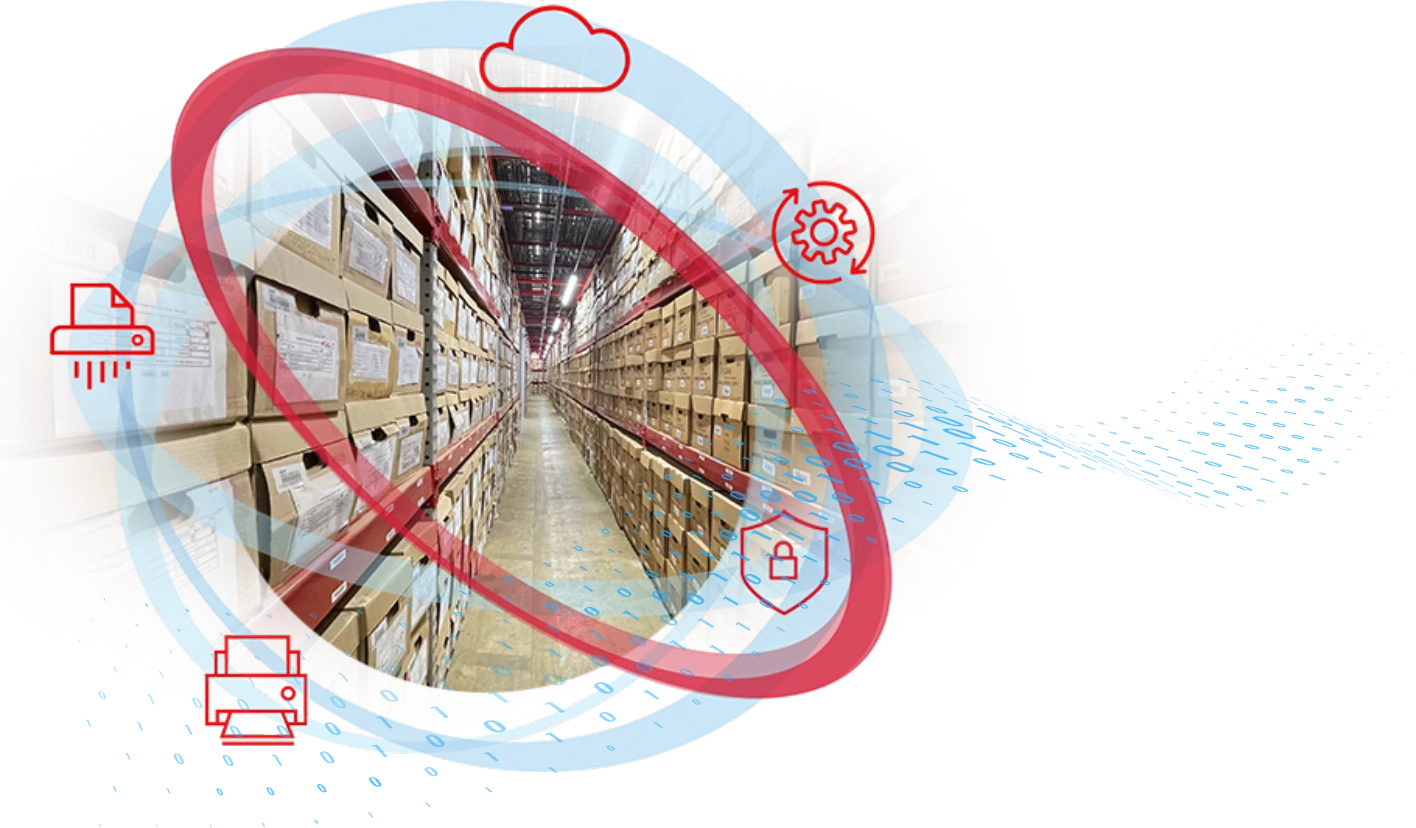
At GRM Information Management, we work with large organizations every day that are dealing with millions of records across physical and digital environments. The reality is this: without a structured records management strategy, costs increase, compliance gaps widen, and operational efficiency suffers.
This guide breaks down how enterprise records management actually works in practice, from storage and retention to digitization and secure destruction, and what to look for in a partner that can support your organization at scale.
WHAT IS ENTERPRISE RECORDS MANAGEMENT?
Enterprise records management is the systematic control of records throughout their lifecycle from creation and storage to retrieval, retention, and final disposition.
Unlike basic document management, enterprise-level records management focuses on:
- Regulatory compliance across multiple jurisdictions
- Secure storage and chain of custody
- Scalable systems for high-volume organizations
- Controlled access and retrieval
- Defensible destruction practices
In large organizations, records exist in multiple formats, paper files, digital documents, emails, and scanned records. Managing these effectively requires a coordinated strategy that integrates both physical and digital systems. At GRM Information Management, enterprise records management is not theoretical, it’s operational. Every record is tracked, secured, and handled with documented processes that ensure accountability at every step.

WHY RECORDS MANAGEMENT MATTERS FOR LARGE ORGANIZATIONS
For enterprise organizations, records management is directly tied to risk, cost, and operational performance.
COMPLIANCE & REGULATORY RISK
Industries like healthcare, legal, financial services, and government operate under strict regulations. Failure to properly manage records can result in audits, fines, and legal exposure.
A structured records management program ensures:
- Retention policies are followed
- Sensitive data is protected
- Records are available when required
With GRM’s scan-on-demand services, physical records can be digitized and delivered quickly without disrupting operations.
Cost Control & Storage Efficiency
Unmanaged records lead to unnecessary storage costs, both physical and digital.
Organizations often:
- Store documents longer than required
- Duplicate records across systems
- Lack visibility into what they actually have
With proper management, organizations can significantly reduce storage overhead while improving accessibility.
Data Security & Risk Mitigation
Records contain sensitive information — from financial data to personally identifiable information.
Without secure handling:
- Documents can be lost or mishandled
- Unauthorized access becomes a risk
- Chain of custody is compromised
GRM Information Management mitigates this through:
- 24/7 secured facilities
- Controlled access protocols
- Tracked handling and delivery
Operational Efficiency
When records are disorganized, teams waste time searching for information.
Enterprise records management ensures:
- Fast retrieval
- Organized indexing
- On-demand access to critical files
With GRM’s scan-on-demand services, physical records can be digitized and delivered quickly without disrupting operations.

Time to take control of your document storage?
Join 1,000s of other businesses that trust GRM.
CORE COMPONENTS OF A RECORDS MANAGEMENT PROGRAM
A successful enterprise records management program is built on four core components:
1. PHYSICAL DOCUMENT STORAGE
Secure offsite storage remains the foundation of most enterprise programs.
With GRM Information Management:
- Records are stored in secure, access-controlled facilities
- Inventory is tracked and managed
- Retrieval is fast and reliable
2. Document Scanning & Digitization
Digitization allows organizations to access records instantly without handling physical files.
GRM provides:
- Scan-on-demand services
- Bulk digitization projects
- Indexed, searchable records
3. Secure Document Destruction
Not all records should be kept indefinitely.
Secure destruction ensures:
- Compliance with retention policies
- Protection of sensitive information
- Verified, documented disposal
4. Retention Policy Management
Retention schedules define how long records must be kept and when they should be destroyed.
A strong program includes:
- Industry-specific guidelines
- Automated tracking of retention periods
- Defensible destruction workflows
RECORDS RETENTION SCHEDULES BY INDUSTRY
Retention requirements vary significantly by industry. Enterprise organizations must align their records management programs with regulatory expectations.

Healthcare (HIPAA)
- Patient records must be retained for multiple years depending on state laws
- Strict requirements for privacy and access control

Legal
- Case files and legal documents often require long-term retention
- Chain of custody is critical

Financial Services (SEC, FINRA)
- Transaction records and communications must be retained
- Auditable access is required

Government
- Public records laws dictate retention and accessibility
- Transparency and compliance are essential
A properly implemented records management program ensures that retention schedules are applied consistently across all record types
| Factor | Physical Records | Digital Records | ||
|---|---|---|---|---|
| Storage | → | Requires secure facilities | → | Cloud or server-based |
| Access | → | Retrieval-based | → | Instant access |
| Security | → | Physical controls | → | Cybersecurity controls |
| Cost | → | Storage + handling | → | Infrastructure + management |
In practice, most organizations operate in a hybrid model. With the help of our Sister company VisualVault we are able to make this a reality for our clients.
GRM Information Management supports both:
- Secure physical storage
- Digital access through scanning and document management solutions
HOW TO CHOOSE A RECORDS MANAGEMENT PARTNER
Choosing the right partner is critical, especially at the enterprise level.
PROVEN CHAIN OF CUSTODY
Your records should be tracked at every step from pickup to storage to delivery.
GRM uses its own delivery drivers and ensures hand-to-hand delivery, maintaining full accountability.
Real Human Support
Many providers rely heavily on automated systems.
At GRM Information Management:
- You speak with real people
- Live agents manage requests
- Support is responsive and accountable
Security & Compliance
Look for:
- 24/7 monitored facilities
- Access controls
- Compliance with industry standards
Scalability
Your provider should be able to grow with your organization across locations and volume.
GRM supports organizations across:
Boston, New York, New Jersey, Philadelphia, Baltimore, Washington D.C., Chicago, Indianapolis, Atlanta, Miami, Houston, Dallas, Austin, San Antonio, Los Angeles, and San Francisco.
Service Integration
Storage, scanning, and destruction should work together not in silos.
This is where many providers fall short.
Large competitors often rely on standardized processes that may not offer the flexibility some organizations need.
GRM focuses on operational responsiveness and tailored service delivery.

GRM’S ENTERPRISE RECORDS MANAGEMENT SERVICES
GRM Information Management delivers a fully integrated enterprise records management solution designed for large organizations.
Core services include:
- Secure document storage
- Scan-on-demand and bulk digitization
- Secure document destruction
- Enterprise document management solutions
What sets GRM apart:
- Real people — no automated support barriers
- Owned logistics network with trained drivers
- Hand-to-hand secure delivery
- 24/7 monitored facilities
- Fast, reliable retrieval and digitization
Whether your organization is managing thousands or millions of records, GRM provides the infrastructure and expertise needed to maintain control, compliance, and accessibility.
FREQUENTLY ASKED QUESTIONS
What is enterprise records management?
Enterprise records management is the process of organizing, storing, and controlling records throughout their lifecycle to ensure compliance, security, and accessibility.
How long should records be retained?
Retention periods vary by industry and regulation. Organizations must follow legal requirements and implement retention schedules accordingly.
What is the difference between document management and records management?
Document management focuses on storing and accessing documents, while records management includes compliance, retention, and secure destruction.
Can physical records be digitized?
Yes. Services like scan-on-demand allow physical records to be converted into digital formats for easier access.
Why is secure document destruction important?
It ensures sensitive information is permanently destroyed and helps organizations remain compliant with regulations.
Learn More About Document Storage Services
Document storage systems are a core part of secure records management.